Tuesday, September 25, 2012

Interesting Origins for a New Piece: At the Round Earth's Imagined Corners


Awhile back I was contacted by Adam Beeken, the fine director of choirs at Lexington (KY) Catholic High School. Adam studied at the University of Kentucky under Jeff Johnson, one of the finest choral programs around. So I knew the choirs at his school would be excellent.

Adam envisioned commissioning a piece for the school choir tour to Chicago in March 2013 and with a theme connecting music with visual art in some way. He approached me about this and I was intrigued, and we proceeded to hash out some of the possible ways to write a new piece with this premise. While Adam started fleshing out the rest of his program, I decided that I could perhaps create a sort of choral version of Mussorgsky's Pictures at an Exhibition. Thus, I would have to make the piece about a few visuals strung together, thus probably a multi-movement piece. I decided that since the choir was coming here to Chicago to sing, that I should make a trip down to our world-class art museum, the Art Institute, and see if there might be paintings that would inspire me musically and in my selection of texts. Since the school is Catholic, I also decided that my destination at the Art Institute should be the fine European Medieval through Renaissance collection of mostly Christian sacred subjects. If I could make a connection between paintings in the Art institute and the texts I chose to set, I would hope that the choir would want to visit the Art institute during their trip to Chicago to see, firsthand, the paintings that inspired their commissioned piece.

Meanwhile some text selection/musical ideas were already beginning to percolate. Not long ago the great conductor Bill Dehning suggested to me that he felt the Williametta Spencer setting of John Donne's poem “At the Round Earth's Imagined Corners” was a fine piece, but really seemed to hastily get from line one of the sonnet to the end. Bill is right, the piece is over in a blink of an eye, usually clocking in at about two minutes. 

John Donne
In addition to the Donne and possibly considering texts by Thomas Merton, I had also been sifting through the bizarre English poet Christopher Smart's oddly fragmented Jubilate Agno (Rejoice in the Lamb) for text shards of interest. You may recall that this is the text source for Benjamin Britten's masterful “Rejoice in the Lamb”. One text fragment which mentions Adam and Eve as well as the crucifixion had interested me. So here were two text ideas, the Donne and the Smart, that were now rolling around in my head.

Christopher Smart


So as I visited the Art Institute, with no time restriction on my wandering that day a few months ago, I wanted to keep a very open mind about what really hit me visually and/or emotionally, while also an eye out for paintings that might mesh with those two texts (of course I was still also considering other text candidates as well). Would I stumble upon some serendipitous meeting of text, painting, and possible musical setting? It was an experiment which I thoroughly enjoyed as I wandered about. I had no idea if anything would come of this experiment.

Adam/Eve 1533/37 by Lucas Cranach the Elder
I decided to start with the oldest Christian art there. And before long I stumbled upon a painting, an “Adam and Eve” by Lucas Cranach the Elder from 1533/37 I had seen in earlier visits over the years. What strikes one about this two panel painting is its rather medieval flatness, the influence of Albrecht Dürer, and the slightly plaintive expressions on the faces of Adam and Eve, and I felt these expressions perfectly fit Smart's mixture of knowledge of Paradise, but also the Fall. The setting utilizes strange harmonies at times, generally minor modes, odd half-step inflections, yet also a major key momentarily ecstatic portrayal regarding the words about Paradise. Musically it draws more from Howells than Britten, and, by the way, I don't apologize for mentioning my English composer muses (which also at times includes other Brits such as Vaughn Williams and Holst).

So I had stumbled upon an expressive, yet somewhat quiet painting and a text with generally the same attributes. Adam had wanted this piece to be appropriate for a large choir, which to me also implies that the piece needs to be ”big” at times, and perhaps also needs to finish “big”. Obviously the theme of Smart's text and this simple Adam and Eve painting would not support the full requirements of the piece, and therefore it did become clearer to me that I indeed needed to write a multi-movement piece. Thus the Smart/Adam and Eve section could perhaps be a short first movement.

Crucifixion by Francisco Zurbarán
Moving along in the Art Institute I came across an amazing Crucifixion by the Spanish painter Francisco Zurbarán. This large (11 ft by 7 ft) canvas is a powerful example of chiaroscuro - a bold black background, with the crucified Jesus in the center. This painting, when viewed in person, is both stunning and overwhelming in its single message. I realized that this was the Crucifixion spoken of briefly by Smart and wondered (over the next few hours and days) if I could perhaps take the message/image of this painting and mirror it by simply setting just the word “Crucifixus” over and over (the full Crucifixus text of the Nicene Creed would be implied). I realized that my setting could be quiet and meditative and/or crying with pain. The possibilities were there for something either intimate or more overtly powerful. As I mulled this over for a few days I decided indeed that I wanted to simply use this one word, focus intently on it, and yet I decided that I would not go over the top with some kind of overtly wounded, painful music. I would visit pain and suffering more subtly through use of some slightly unusual melodic intervals and also a chorale section with unusual harmonies (almost sounding like early Renaissance Spanish music) but keep this setting, for the most part, in the zone of intimacy- as if this would be the music in one's head during a “Stations of the Cross” arrival at station eleven.

So, now I perhaps had two movements, linked to some extent by the Crucifixion theme, but also both probably introspective and not implying a “big” sound for the choir.

In the same room as the Zurbarán was a large painting by Francesco Buoneri of the Final Judgment, the theme of the beginning of Donne's sonnet mentioned above. I realized I truly should set the Donne as the final section. After all, my developing story included major highlights of Christian history; Adam and Eve, the Crucifixion- why not arrive at the Final Judgment as a conclusion? I kept studying this painting but was having a hard time truly liking it. It just seemed a little underwhelming and even a bit mundane in its imagery. I wandered the whole building looking for something else along these lines, as I came to believe that a powerful setting of the Donne would not only round out a three movement piece but also give me a final section which would certainly be the “big” music I needed for the choir. But nothing else in the building visited the theme of Donne's text and I struggled for awhile with that disappointment.

I contacted Adam and told him of my text ideas, the idea of a multi-movement piece, the paintings I had seen and so on. Adam was thrilled with my progress and we discussed whether or not this piece, now to be longer in duration than originally planned and contracted, would still fit his needs. He said it was fine with him and I gradually started setting the texts.

So here was the final plan- the piece would start with the setting (about two and half minutes) of Smart's text (linked to the Cranach painting), a slight pause and continue (also about two and a half minutes) with the single word Crucifixus section (linked to the Zurbarán painting), and then proceed to a four minute setting of the Donne (with or without a painting twin), which would contain plenty of uptempo, loud sections. Thus the Donne is the destination and the piece takes that title. Musically the sections can perhaps stand apart, yet when sung from start to finish, there are elements that unite them, notably the early and mid-twentieth century English school melodic and harmonic influences mentioned earlier (the Donne section is very Holst- influenced, it might remind one of his Rig Veda music), a certain angularity to some of the melodies, but also conversely the importance of carefully chosen semi-tones in coloring melodies or turning harmonies in an unexpected direction. Adam wanted the piece to be challenging for his choir, yet still doable for high school voices. I paid close attention to ways to make this happen, and since the piece is SATB/piano, the piano allows for more adventurous music since it can help hold things together. The piece is very lyrical and I make sure that all voice parts take turns at singing melodies or leading in various ways. There is counterpoint of varying degrees as well, something missing in about 90% of the current cloying, homophonic American choral style. I also took care in writing for the men's voices- they go to divisi rarely and the ranges stay reasonable. All in all, I think I highly succeeded in this adventure that Adam sent me to explore! I am so thrilled that we have worked on this together and I am very excited to work with him and the choir as they prepare for the premiere of the piece and their trip to Chicago.

Post Script

As I was setting the Donne text I gradually realized that the real point of the sonnet is not the Final Judgment. I will plead guilty to being stupid for not noticing this much earlier, but the real theme is personal prayer, personal repentance, and a personal relationship with God. It's all right there in Donne's words, but I guess the epic drama of the Final Judgment imagery sure can get in the way. I now feel that the most important ideas are the very personal soul-searching lines which I set in an intensely lyrical, slow speed- not the uptempo Final Judgment lines. Thus I became aware that I should revisit the Art Institute and seek a different painting which reflects this new understanding of the Donne text. Well lo and behold, there is a painting literally a few feet away from the Zurbarán Crucifixus I admire and also that Final Judgment painting I didn't really care for that much. It's a painting by another Spanish artist, Jusepe de Ribera, of St. Peter intensely bemoaning his betrayal of Jesus. And while the story isn't one of the Final Judgment, it is one of deep personal searching, of great intensity, and of a personal dialogue with God about our own personal shortcomings and failures. The painting itself (probably influenced by a more famous El Greco version) is very powerful, the upturned face of Peter is anguished, yet it also seems to hold out hope for resolution with God. I realized that this painting truly fits the real message of the Donne poem.

The Penitent St/ Peter by Jusepe de Ribera


So, in conclusion, this project was unique, especially the steps I had to take to make all these elements relate to each other. And yet, can the composition succeed without these specific visual reference points? Yes, of course it can, but I still feel that telling the story of the project as Adam and I developed it, makes the final piece of music much more interesting, intense, and powerful.


The Texts of Each Section

The Christopher Smart text:

For the Glory of God is always in the East, but cannot be seen for the cloud of the crucifixion.
For due East is the way to Paradise, which man knoweth not by reason of his fall.


The Nicene Creed text:
Crucifíxus (etiam pro nobis sub Pontio Pilato;
Passus, et sepultus est,
Et resurrexit tertia die, secundum Scripturas,
Et ascendit in cælum, sedet ad dexteram Patris).

The Donne text:

At the round earth's imagined corners blow
Your trumpets, angels, and arise, arise
From death, you numberless infinities
Of souls, and to your scattered bodies go ;
All whom the flood did, and fire shall o'erthrow,
All whom war, death, age, agues, tyrannies,
Despair, law, chance hath slain, and you, whose eyes
Shall behold God, and never taste death's woe.
But let them sleep, Lord, and me mourn a space;
For, if above all these my sins abound,
'Tis late to ask abundance of Thy grace,
When we are there.   Here on this lowly ground,
Teach me how to repent, for that's as good
As if Thou hadst seal'd my pardon with Thy blood.


Monday, September 17, 2012

Thoughts on Text Setting (Current Compositon Projects)

 Part Two

Well let me preface this blog entry by stating that, yes, I have not been blogging much at all lately. I have been too busy composing and hanging out with Aidan, my cool and crazy eight year old- so that's a good thing! Now, as I finish up on most of my commissions that will be performed this concert season, I can get back to blogging, although I still have plenty of music to write for now and down the road. Here is a discussion I began writing awhile ago of a piece which was finished in mid-summer and which will be premiered in early November:

This past Spring I was contacted by Roger Dean/Lorenz, my main publishers, who told me that they had recommended me to Larry Doebler at Ithaca College to compose the commissioned work for the 34th annual Ithaca College Choral Festival to be held in November. I was quite happy with this news, and this is the first time a publisher actually produced a commission for me. Until now, almost all my commissions have come through the growth of personal relationships with people around the country, with the other few commissions the result of people who have sleuthed out my music and called me without first having a relationship (hey, any of these is fine!).

I learned more about the impressive history of the Ithaca Festival and read up on the names of those composers who have already written the commissioned piece and was pretty humbled- names like Vincent Persichetti, Steven Stucky, Chen Yi, fellow Yale classmate Dan Asia, Dan Locklair, and others.

I got to know Larry Doebler through e-mail, (what a nice man), and started looking for texts to set for this piece which was to be 4-6 minutes and for SATB a cappella or accompanied (my choice). At first I thought of doing a traditional Latin church text setting- the Persichetti commission was the first piece in the series- and as he set the Magnificat and Nunc Dimittus, I thought of reprising that, but then I decided I wanted to do something more modern as well as serious and substantive. So the poetry search now needed to be a thorough hunt for something truly special. I wouldn't just accept any old text, that was for sure. I felt it might take quite along time, but actually a poem I already knew just a little virtually leaped into my lap pleading for me to choose it- Amy Lowell's “September, 1918”, a war poem very different from other war poems as it is not about the battles themselves, but one civilian's reaction to the possible ending of war, whether an outbreak of peace could be trusted, and so on. I have always wondered about this- as WWI and WWII dragged on, how much did people wonder if the war would ever end? What would be the final toll both physically and psychologically on us all- how did we go from living in a fairly peaceful world, then to the mindset of being in the midst of world war, and then somehow back again to peace? This is something I have not experienced, yet this was reality for the generations of the first half of the twentieth century.

SEPTEMBER, 1918” (with line numbers added for study)
by Amy Lowell
1. This afternoon was the colour of water falling through sunlight;
2. The trees glittered with the tumbling of leaves;
3. The sidewalks shone like alleys of dropped maple leaves,
4. And the houses ran along them laughing out of square, open windows.
5. Under a tree in the park,
6. Two little boys, lying flat on their faces,
7. Were carefully gathering red berries
8. To put in a pasteboard box.
9. Some day there will be no war,
10. Then I shall take out this afternoon
11. And turn it in my fingers,
12. And remark the sweet taste of it upon my palate,
13. And note the crisp variety of its flights of leaves.
14. Today I can only gather it
15. And put it into my lunch-box,
16. For I have time for nothing
17. But the endeavour to balance myself
18. Upon a broken world.


                      (Amy Lowell)


Examining the text, certain things become apparent- there is an excitement at the beginning-a description of beauty and action- of sunlight, water, tumbling, houses running(!), laughing- a whole jumble of delirious actions and events. What reader encountering only these early lines in the poem would guess this is a poem that is, in some way, about war? And right here, the poem grabbed me- I am certainly very attracted to texts that work on multiple levels, that are open to multiple interpretations, that contain mystery and so on. Also at this point, the level of action attracted me, this proposed setting could have wonderful contrasts of tempo, something which appeals to me these days as I see so many US choral composers in the past twenty years writing everything at a ponderous, homophonic, soprano-dominant, 60-72 beats per minute. This text would provide ample opportunity for uptempo writing as well as more reflective moments.


So once I truly decided to set this poem I ran it past Larry and he gave it a quick approval. I became pretty excited about the project and started on it with plenty of zeal. But of course, there needed to be a lot of study of the poem, both before I wrote a single note, but also as the piece progressed. I usually start at the beginning and end at the end. Sometimes as I do this I will happen across music for a later section of a piece and try to sketch that or even write it out and lay out, in my Finale score, a slew of blank measures that will be needed in order to arrive there later. So while I tend to write linearly in time, sometimes I jump about (hopefully not like a yak- Sir Thomas Beecham wouldn't approve of that.*

So the poetic study reveals some things which are pretty obvious- there is a dramatic shift with absolutely no warning as we go from line 8 to line 9. There it is, the whiplash inducing mention of war, and apparently a proclamation that there someday will be no war(?). But can we actually trust this statement of the poet- especially when we were ambushed by even the mention of war? Does she really convince us or even herself with this statement?

Our answer comes from lines 10-13 and the subsequent information in 14-15 inform us that all these delightful images and actions in lines 1-8 truly were never trusted by the poet. They were noted but never truly enjoyed, they were put away for perhaps a future when it is okay to enjoy life.

Lines 16-18 are the final sad thought and commentary- the happiness cannot be enjoyed because the poet can do nothing but try to survive, “to “balance myself on a broken world”. Even though in September 1918 it seemed as if the war was coming to an end, the world could certainly not be trusted. And so this poem which began with such positive, ecstatic images ends in distrust and sadness. The poem has traversed so many emotions and truly given us a kaleidoscopic tour of the mind of a citizen living in time of war.

So here were the challenges ahead of me- how could I pull off representing all these emotions and how could I set that line 9, and those final sad thoughts to the best of my abilities. Big challenges, indeed.

Here were some of my solutions (the piece is already almost done, far ahead of schedule, by the way).

The opening lines are set to up-tempo music, a busy triplet theme in the piano intro sets up the busy-ness and this theme will come and go through the piece- it's the theme (almost solely in the piano) that represents the busy action parts of the poem. But to hint at something darker, there are already slightly strange dissonances in the piano and/or the voices in an otherwise major (or suspended 4th- no third) tonality. These odd, momentary dissonances are the slight clue that all is not happiness and bright and that things will change in this piece from light to dark. Btw, the vocal parts in this opening sound a bit like Randall Thompson or Vaughn Williams, a number of simple chords moving variously in parallel or contrary motion to each other.

The music dies down and then the line 9 text arrives. Here there is a cross-relationship battle between major and minor chords, as well as conflicting major and minor scalar motion (somewhat like the odd scalar conflicts in Tallis). The men's voices intone the beginning of this in a repetitive dirge-like manner, and the women layer on top of this in long, ascending stretto lines. The setting of this line of poetry ends with the very loud, highly pitched culmination of this dirge and ascending stretto- I expect it to be pretty powerful when it is sung by the choir.

The text of line 10-13 suggest a return to the feelings (and music?) of the opening. I do actually do this, but certainly not verbatim at all. At first the return is dreamlike- text from lines 10-13 fit the music of the beginning but the tempo starts slower, as if we were trying to recapture that opening feeling, but were having some difficulty doing so. Finally, the tempo does get back to the beginning tempo but before long we have arrived at the ending lines of poetry. There I use a device I have used in two earlier serious pieces- setting a text line or two in a chorale-like way, as if that text were perhaps the core, or the message, or moral of the entire poem. These chorales (often just a few bars long, especially in this piece) are usually in 4/4 time and may contain suspensions to draw attention to important words. It's as if the music has to become simple so that we hear the message from this Greek chorus. The line where this is the most obvious is line 16 “for I have time for nothing”, meaning literally no ability to appreciate anything of beauty. In this context, the statement is quite drastic. It means we virtually cannot endure war and its psychological destruction of the human spirit. The chorale weaves in and out as the poem and music end, and there is also a reference to a very simple melody which also has a very piquant harmony attached to it which was used way back in lines 7-9- about the innocent little boys. And then we finish in a choral unison of the last words “to balance myself upon a broken world”. I wrestled with how to set this ending quite a bit (and probably am still doing so, since I have plenty of time to tweak this piece). What does it mean if I set it chordally or if I set it in unison, what is the psychology of each? I am not sure I can totally put answers into English in response to this, but I kept coming back to the fact that a unison setting of the final words gives them more power- there is no distraction by choral harmonic sound, and there is also a unification of thought through the whole choir- hey are all delivering the message together. So I think this really is the best choice for the ending.

Currently the piece clocks in at about six and a half minutes. I talked to Larry to make sure I hadn't overshot the commission length too much and he was fine with it. We'll see how my final tweaks affect the duration, and what other tweaks happen-- I'm always playing with choices in regard to the exact dynamics, tempi I am going to mark in a piece. I'm also constantly trying to figure out just how long final notes of phrases for singers (especially if they are a hard consonant) should be and whether they end on a strong or weak beat (yes, these tiny details of release points can make a difference to the sound and also the psychology of a setting).

I'm very pleased with the piece so far and I hope that the audience is drawn into the drama and personal voice of this war poem set from the point of view of a civilian. I think it is one of Amy Lowell's very best works. She is not a major poet but she certainly had her own voice, and it is still fresh enough to speak to us, unlike a number of other poets of her generation.

P.S. The other two pieces where I have used the chorale idea are in a setting (for SATB and strings, one on a part or larger ensemble)  which I titled “1944” from H.D.'s poem “Christmas, 1944” where I use the music from chorales in the J.S. Bach Christmas Oratorio to set some of the words, and also a piece called [HUSH] which is about divorce and young children surviving that situation (the divorce references in that poem are actually quite veiled). 

* "What can you do with it? It's like a lot of yaks jumping about".
- Sir Thomas on Beethoven's Seventh Symphony


Thursday, June 14, 2012

Scott Tucker to succeed Norman Scribner at Washington Choral Arts Society

 I recently was contacting Scott Tucker of Cornell to let him know I would be in the Ithaca, NY area this November (the Ithaca College Choral Festival has commissioned me for a work for their great fall festival) when I found out from Scott that he is leaving Cornell to succeed Norman Scribner as director of the Choral Arts Society in Washington. Wow- what an amazing appointment for Scott! I wish him much success. I especially love to hear that Scribner is handing over his group graciously and lovingly to Scott.


Here is a Washington Post article about the appointment:

Scott Tucker to succeed Norman Scribner at Choral Arts Society

Courtesy of Cornell University Glee Club - Scott Tucker will be the new music director of the Choral Arts Society.

The Choral Arts Society has announced the successor to Norman Scribner, who is retiring as planned at the end of this season from the chorus he founded 46 years ago. And he’s not anyone most people in Washington have heard of.
Scott Tucker, the choral director at Cornell University since 1995, is retiring from his tenured position leading the university’s choruses to take over from Scribner.

“I was craving a new adventure, a new challenge,” said Tucker, 55, of his impending career change, which takes effect at the start of the 2012-13 season.
“Conducting is educational, no matter who you are working with,” he said, “even in the professional world.” He added, “My students at Cornell are not music majors. They’re very bright, motivated students who see music as a release, more than anything, but who bring to it such passion and intelligence. I don’t see that as being so different” than the Choral Arts Society. Furthermore, he will have more consistency with the singers in Washington as opposed to a student group: “As soon as they’ve perfected it all, they graduate.”
Tucker was one of four finalists who came in this season to work with the 170 members of the amateur chorus after Scribner, now 76, announced his retirement in August 2010. The search for his successor became an international one, with about 80 applicants. Tucker applied cold, without any inside connections.
“It’s such a surprise for all of us,” said Debra Kraft, the executive director of Choral Arts, speaking yesterday after the board’s unanimous and rapid confirmation of Tucker’s official appointment. “It came from a source we never expected.”

Tucker’s experience includes fundraising (of particular interest in today’s climate), commissioning new work — he commissioned more than 30 new pieces while at Cornell, including works by Augusta Read Thomas, Chen Yi and Libby Larsen — and world music. He spent part of a sabbatical year in South Africa, learning traditional music by rote from an expert who requested that he not write anything down, saying, according to Tucker, that “those staff lines are like prison bars to the music.”
“The freedom with which you sing that kind of music,” Tucker said, “can be directly applied to [Bach’s] B minor mass or [Beethoven’s] Missa Solemnis. Maybe not the vowels, but the spirit.”

The Choral Arts Society, founded in 1965, has long been a flagship chorus in a choral-oriented city. It has worked with generations of National Symphony Orchestra conductors and other leading artists, including Mstislav Rostropovich, Christoph Eschenbach and Valery Gergiev (with whom the chorus recorded Mahler’s 8th Symphony in London in 2008). In August and September, it will be touring Europe with Leonard Slatkin in performances and a recording of Berlioz’s Requiem.

All four of Washington’s big symphonic choruses have experienced sea changes in recent years as their music directors approached retirement age. The Master Chorale of Washington shut down in 2009; two years earlier, the Washington Chorus ushered out its longtime director, Robert Shafer, and eventually hired the 40-something Julian Wachner. (Shafer promptly founded the City Choir of Washington, now in its fifth season.) The Cathedral Choral Society is seeing major staff changes this season, although J. Reilly Lewis remains at the musical helm.

In this climate of transition, Scribner wanted his succession to proceed smoothly. He presided over the search without actually involving himself in the decision-making process. “It’s been wonderful, reassuring to everyone,” Kraft said, “to know that the process had his blessing but not his interference.”
“It’s almost like a parent watching a child and hoping they’ll pick the right mate to marry,” she said. “You can’t do an arranged marriage, but you hope they’ll pick the right one.”

In a statement, Scribner said, “It is a joy for me to welcome Scott Tucker as the new artistic director of Choral Arts.” His successor’s talents, he added, embrace “an intense natural musicality, a consummate technique, a fabulous ear, and a vast reservoir of knowledge and experience in virtually all periods and styles, together with a clear vision for the future of music in our own time. . . . Scott’s appointment heralds a brilliant new era in the Choral Arts Society’s pursuit of excellence in the choral arts.”

Monday, June 4, 2012

Summer 2012 Composer Newsletter

Here is what's been going on in the life of a not-yet-dead composer.

I wrapped up my very rewarding year as composer in residence with the many choirs of The Young Naperville Singers, artistic director Angie Johnson. The students were amazing (330 singers in eight choirs, ages from 6-18) and four new pieces came from this collaboration- some of them easy-ish SA to more involved SSA or SSAA suitable for HS and beyond women's choirs. Let me know if you'd like to see perusal scores (FYI, two of the pieces are Christmas music- one is very festive and has optional handbell parts).

I was thrilled to judge for Heritage Festivals for the first time this spring. They are a wonderful organization and I was very fortunate to get to clinic one of the great choirs there- the amazing Mason City High School Choir (IA) led by Joel Everist.

My sometimes gorgeous, sometimes gnarly double choir re-imagining of Billings' “When Jesus Wept” received two more performances. This is a piece no publisher will touch- they don't want double choir, counterpoint, or anything really creative- so it will remain self-published. The performance led by Patrick Dill (great DMA student of Richard Sparks) at University of North Texas was excellent. You can hear a recording here:


Coming up this summer and next season:

I will be presenting an interest session at the Missouri ACDA meetings in mid-July. The subject is how to commission effectively for your choir and I will guide the attendees through how to do this right and keep it pain-free. After a period when a number of session leaders were covering this topic around the country it seems like no one has been doing it of late. If you'd like a copy of my two-page outline for this presentation, let me know. And while I am there Paul Crabbe's wonderful choir “Voices of Prometheus” will premiere a new piece with a clever battle of the sexes text by Philip Marlowe called “Dirge for Love”. I'm looking forward to hearing them have great fun with this piece (SSAATTBB a cappella).

Speaking of commissions, I am really excited to have been chosen to write for the ACDA Women's Choir Commissioning Consortium led by Iris Levine. I've already been working hard on this piece, a setting for SSA/piano of "Full Fathom Five" which will be presented by over thirty top women's choirs around the country. Wow, talk about good fortune- that's a lot of choirs premiering a new piece. I have some other commission orders too- the other big one is for the Ithaca College Choral Festival in November. This will be a setting of an amazing anti-war poem by Amy Lowell. Hint- I still have time on my schedule for more commissions and short or long term residencies for 2012-13. E-mail me if you are interested.

You made it- you survived another school/concert year and lived to tell the tale. Take a deep breath, enjoy the summer a bit, but I know you are already thinking about repertoire for next year! So with that in mind here are some pieces of mine which might really spice up your December programs. Let me know if you would like any free perusal scores of these pieces. I will just highlight a few- you can view a complete listing with details, score samples, etc. of all of my many Christmas, Hanukkah, and Winter Solstice scores by visiting:


One of my holiday bestsellers is the Hanukkah song "Unending Flame" with a truly nice text (so many Hanukkah texts are awful, I think you will agree). Voicings available are SA or SABar. There is also an orchestration for this piece which really makes it pop. You can see a beautiful video we created for the piece and hear the orchestrated version here:


Another bestselling piece which can be either with piano or orchestra is my very dancey SSA version in mixed meters of I Saw three Ships:

http://paulcarey.net/Music/I_Saw_3_Ships.htm


If you are looking for SATB works, Nancy Menk made a very nice recording of my lyrical “Hush my Dear, Lie Still and Slumber" which you can hear:  


I also have a piece with a similar feel to it- my arrangement of “Gabriel's Message”, available in manuscript.

Finally, some pieces with brass. First up is “Christmas Bells”, which was commissioned by Edie Copley at N. Arizona University. This is big and festive (yet with a very introspective middle section)  for SATB/brass/organ/perc/handbells.  The ending will ensure that your entire audience is awake:

http://paulcarey.net/Music/Christmas%20Bells.htm

The other brass piece is not as festive since the text by the brilliant Thomas Merton is generally more reflective- it's called “The Winter's Night Carol”. I don't have a good recording yet of the piece due to miking issues at performances, but I can certainly e-mail you a score if you like!

So there you have it- all the things I am doing while not sleepwalking, crashing stock cars, or lobbying Congress to make the Congo Buffalo our official national pet. And please accept my sincere thank you to those of you who perform my scores. Without YOU they make no sound!

Tuesday, May 29, 2012

This Famous Living Composer needs an Ego Check


It seems to be true that if you hit it big, you can become a jerk (or maybe you always were one), and people will allow it. This even seems to hold true in the rather tiny world of composing within the tradition of classical music, where there is usually no real money to be made for 99% of those attempting in one way or another to make some kind of living.


Photo: Oswaldo Golijov (perhaps the dude pictured on the music on the piano might be the next rip-off target, hmmm?)

This post is my take on the Oswaldo Golijov musical plagiarism debacle, scandal, or tempest in a teapot, depending on who you want to agree with. The story starts somewhere- but that beginning is kind of murky. You almost have to sleuth this one backwards in time and use something called a brain to get it right for yourself.  Mr. Golijov's simplistic explanation these days is not to be trusted- it's a fairy tale all about a melody and a few other strands of musical material he claims he and another person devised in the past and how it came to be used (over and over and over- hmm). Oh, by the way, Mr. Golijov is an uncle to half of Milli Vanilli.

Here's how things unfolded, as explained by Anne Midgette of the Washington Post

From pastiche to appropriation: Golijov and “Siderus”


"This week finds the composer Osvaldo Golijov dealing with accusations of plagiarism: his piece “Siderus,” co-commissioned by a consortium of 35 orchestras, premiered in 2010 in Memphis, appears to contain chunks of a work by the accordion player Michael Ward-Bergeman. The piece was played by the Eugene Symphony this past weekend, and two men in the audience -- Tom Manoff, a critic for NPR, and Brian McWhorter, a trumpet player -- were startled to recognize large chunks of Ward-Bergeman’s piece, which they happened to know intimately because they had worked together on a recording of it.”

You'll need to ead the whole article here (you can also Google “Golijov” and find plenty more news and opinions):


The highly respected arts commentator Alex Ross and many others have weighed in on the subject, some defending Golijov's pastiche and “borrowing” (citing the long history of such in classical music) while others have gone for Goliyov's jugular. These folks point out that he's done this before, and in addition he's abused the musical world by being late on fulfilling commissions, submits works substantially shorter than the agreed upon commission length and other offenses. After a period during which he ignored the situation, Golijov finally offered up a pale explanation and pretty much no apology. In regard to his tardiness in fulfilling commissions his only response was “Composers shouldn’t be judged by being late,” he said, “but by being good.” Wow, tell that to an orchestra's artistic staff, music librarian, publicity department, and so on. They'd be thrilled to hear that, eh?

I bring this all back up because current news reveals that a Golijov violin concerto promised for premiere in the Spring of 2011 and more recently scheduled for a performance in April 2012 has not been finished. The next scheduled performance of this phantom piece is set for Fall 2012. We'll see if it gets delivered in time for that and if it is just “Barbeich” and “Siderus” rearranged Pizzicato Polka style perhaps? In addition, more people are also discovering that the “Siderus” piece and its relationship to Barbeich” is actually preceded by a Golijov piece called “Radio” commissioned and paid for by a NYC group. So apparently this ”amazing” music is so important to the universe that it keeps appearing with different names, as a commission paid for over and over by countless foolish groups, etc. Or could there be a connection to the Mayan calender predicting the end of the world in December 2012? Will the celestial tones of Radio/Barbeich/Siderus reverberate around us all in the final moments of our existence? This, I believe, is why we should cut Golijov slack, my friends. He has been chosen by the universe to composer music for our end credits.

New thought flash- why do the titles of all these pieces sound like the names of Cirque du Soleil shows? And actually, don't the pieces sound like Cirque music?

One cool dude, composer David MacDonald, has actually put together a side by side comparison in real time of Siderus and Barbeich- oh my Lord, the pieces are in the same key and even the same exact tempo- amazing.


One other thing I am amazed by- all of the many consortium commissioning orchestras are (at least publicly) just accepting this piece and not a single one has complained out loud or, to our knowledge, asked for their money back. Could it be they are too embarrassed to want to say anything for the record- to admit they were too stupid and musically uninformed to know this was all happening? It actually makes me grin to think that this piece (which no matter the controversy- is pretty lame and musically inconsequential) was in honor of Henry Fogel, who made a big mess managing the Chicago Symphony Orchestra here in Chicago after Georg Solti retired. We are just now getting back on track after dozens of years of decline. Thanks to Fogel's successor, Deborah Card, and Riccardo Muti we're putting the recent dreadful and dreary Henry Fogel/Daniel Barenboim days behind us.

So as people yammer back and forth about whether Golijov's behavior was acceptable as a composer/human being/signer of a contract, etc. here is what people have forgotten to talk about and what I want to add to the discussion-- and what is actually more important than Golijov and his ego: how this affects all the many other talented orchestral composers who would have leaped at an opportunity to write a “new” (whatever that means, I guess) piece for thirty-five top orchestras and accept the lucrative fee that went along with that contract and job. This would be a dream come true for many very skilled composers out there, and possibly a breakthrough for someone who did it well. But no, the big gig and the big money goes to the “name” composer even if he is an asshole. He can gleefully rip off other people's pieces or slip them some money for their piece, stick his name on them, deliver them late and well short of the duration time requested like he doesn't care, and laugh all the way to the bank. I recall hearing recently about another big name composer who was two years late with a choral commission. Why didn't the choir just cancel the contract and demand that their deposit be returned? They had every legal right to do so. But they let the big name slide because I guess the big-name is so very ”special”. So my focus here is how do talented, but lesser-known composers feel when this stuff happens? Personally in the choral field I'm doing pretty well- so while this situation steams me quite a bit, I can't even truly imagine how much it steams talented and reasonably ambitious, yet still ego-healthy orchestral composers who  have difficulties getting their music known. Hmm, maybe I should ask a few of them- so I did ask one - and here are some of the thoughts of Thomas Dempster, a very fine composer, please visit Tom's website at www.thomasdempster.com :


The most-prominent and revered composers working in America today largely need to…
a) stop biting off more than they can chew regarding commissions and other such things by taking so many…
b) be brought back down to Earth and reminded that they are human as well and should therefore suffer with the rest of us…
c) not be given carte blanche regarding deadlines for important commissions when there are hundreds of us out there who write as-good (if not “better”) music champing at the but…
d) all of the above.

I’ve never particularly liked Golijov’s music or his compositional voice. It’s like someone spilled more dissonances on Manuel de Falla and mixed with B-level John Adams all while pretending to be Jon Brion or Howard Shore. But even then, I respected him. Ainadamar is a fantastic piece and should really go down as one of “the” operatic works of the next 50 years, despite what I think of it aesthetically or personally; technically, it works, and it's Golijov's voice, as best as I can tell. It's authentically his.

I have lost any sort of respect for Golijov after this debacle, though, and I hate what this could do to corporate and citizen sponsors of new-music composers, at least for the short term. This also makes all composers (or further reinforces the notion, false or not) seem like thieves or unoriginal. We’re original insofar as our influences become confluences: Americans who speak English all speak slightly differently from each other, and it’s those voices different from our own that pique our interest the most. We’re original insofar as our own voice has been shaped and is mature and can offer a rich vocabulary beyond the constabulary of neutrality that inhabits the vast majority of musical spaces. And Golijov went on and inverted that and created an affront to something we aspire to. Especially since Sidereus - his (or “his”) piece in question - is actually noticeably different from his regular voice, and the piece itself - beyond the, ahem, extended Ward-Bergeman “quotation” - is too sparkling, too riddled with consonance, too jagged at transition points to really be Golijov’s, in the biggest sense of the word. This is not a stylistic shift or a new development - this is Golijov affecting an accent, and he was called out on it.

Most troubling is the silence that emerged afterward. There were no discussions, publicly anyhow, among the consortium of orchestras that commissioned Sidereus to pull the performances or ask for a refund. Ward-Bergeman hasn't gone on record, and I question the ethics of that small-name composer if he was willing to part, for a price, with a piece of his, knowing he'd not receive continual credit or recognition, knowing he'd never be able to.

But then, we have to consider the cover song in pop music. To some degree, one artist buys out another through licensing and freely takes on the role of reconstruction worker to remake the song in his or her own voice. It may be a model shift or a difference in culture, but in art music, the quotation is short and well-placed; a quotation isn't the complete work spun round with someone else's name on it. There is no culture of a "cover artist" in classical composition - the closest we come is in having different ensembles and performers, but it's practically unheard of for a composer to "cover" another composer. And I largely don't think the art-music culture will ever embrace that.


Thanks to Tom for sharing his thoughts. And many composers who continually get passed over for good opportunities and commissions eventually tire of the situation and just quit composing, a really sad loss in my opinion. And I will say for myself, I hate Golijov's attitude about this- he has no respect for the performers or the organizations and makes all composers look like jerks. I resent having to being guilty by association because of him and others like him. I've never been late on a single commission and I have never rushed a piece just to finish one. We'll see how Golijov's world develops as hopefully, some people become wary of his behavior, but for now I just wanted to get my two cents worth in about how unfair this is to the many struggling composers out there who truly are trying to compose with a fresh, personal voice of their own.

Oh, by the way, lately I've seen some composer contracts that actually state that the composer signing the contract must write the piece him or herself. This looks to be one obvious result of the Golijov debacle, I guess. It's fine with me, but kind of evidence that what he did is now held against the rest of us. 


Wednesday, May 23, 2012

BBC Radio features Chicago A Cappella and one of my spiritual arrangements


I was thrilled today to get an e-mail from Jonathan Miller, founder and artistic director of Chicago A Cappella. Jonathan let me know that a number of tracks from their early 2012 Spiritual Concert entitled "Wade in the Water" were featured on the BBC Three Radio show “The Choir” hosted by Aled Jones this past week and that for a few days more anyone can go and listen to the program online. One of the featured pieces is my arrangement of the very soulful spiritual ”Blind Man”.

Chicago A Cappella is one of the few Illinois-based choirs that has shown continued, strong interest in my music. I am always kind of surprised and I guess bemused by the lack of interest, in general, in my music from Chicago and Illinois groups and directors. At times I feel I am much more appreciated in Portland and Seattle, or South Korea, or Michigan or just about any place other than here where I live (oh well!). Anyway, I have always been thankful to Jonathan and CAC mover/shaker (and great baritone) Matt Greenberg as they have regularly embraced my spiritual arrangements and other pieces like “Play with your Food” (yum, mashed potatoes) over the last ten years.

These days I feel spirituals are being unfairly ignored. I suppose this is a reaction to the many years where the big honking loud ones were used as kneejerk concert-enders. Some directors apparently grew tired of seeing them used in such a cliched way and stopped programming them altogether. Yet today, all these (admittedly concert) arrangements of our special musical history should not be ignored. Please, choral folks- especially younger directors, listen to more of this music, embrace it, and start programming it again. It comes from the pain and suffering of real people, and then somehow, through the magic of music, transcends that pain- either in a radiant, quiet glory or shout out celebration. It's time for more people to get back to this amazing heritage- whether it is the arrangements from back in the day (Burleigh, et al), the more modern arrangements by Moses Hogan and Adolphus Hailstork, and also the very newest arrangements done right now by just a handful of dedicated composer/arrangers who don't mix in annoyingly inappropriate jazz or gospel threads into the form. By the way, you might want to read my review of The American Spiritual Ensemble's amazing spiritual concert in Memphis a couple years ago, for more thoughts and ideas on the spiritual tradition. This was one of the great choral concerts I have heard in my lifetime. You can read that here: 


But now please visit BBC Radio soon to hear Chicago A Cappella sing a number of spirituals. Their portion of the program, which originally aired May 20th (the title of the program “American Sardinians” is a reference to the lead story) begins at the 52:00 minute mark, and my piece begins at 1:01:15. I'm tickled that host Aled Jones singled out “Blind Man” with a few words of praise- describing it as “haunting” and then also taking the trouble to give the Biblical reference point for the story. Thanks, Aled- gotta love the Brits!


PS Don't miss Cari Plachy Dinglasan's wonderful solo turn on Robert Morris' “Save Me, Lord”.


Monday, May 21, 2012

Thoughts on Text Setting (Current Composition Projects)


Thoughts on Text Setting (Current Composition Projects)

Part One: Shakespeare's “Full Fathom Five”

I thought I might give some insight into how I choose and set texts. Some people might be really interested in this, and some may find it a bore. But here we go:

The first text I will share with you is one you may know from HS literature classes- Ariel's Song “Full Fathom Five” from “The Tempest” by Shakespeare. I have never set a Shakespeare text until now- I think I have been put off by how many Shakespeare settings there already are out there, plus the language issues- the Elizabethan syntax sometimes is a bit elusive for modern readers. I was actually looking at some SATB settings of this text as part of a lesson on text-setting, and I finally knew it well enough that I began to like it as a possible text to set myself, this time for a women's choir commission through Iris Levine and ACDA. So my setting is different than the ones I was studying- SATB a cappella settings by Ralph Vaughn Williams, Jakko Mantyjarvi, Reginald Unterseher, and Matthew Harris.

Here is the text (with text line numbers added for study):

1. Full fathom five thy father lies;
2. Of his bones are coral made;
3. Those are pearls that were his eyes;
4. Nothing of him that doth fade,
5. But doth suffer a sea-change
6. Into something rich and strange.
7. Sea-nymphs hourly ring his knell:
8. Ding-dong.
9. Hark! now I hear them — Ding-dong, bell.

The poem's meaning needs to be discovered first, and a reading of the Tempest will supply it. Prospero has ordered Ariel to sing this song to Fernando, in hopes of fooling him into believing that Alonso, his father, has died when their ship broke apart. Thus the sprite Ariel is singing a song of death and strangeness which actually isn't true at all- yet its goal is to create confusion in the minds of the characters Prospero attempts to control.

To set the poem one of the first things to do is to determine how the length of the poem will guide the length of the setting (how much repetition will be used, any harkening back to earlier lines, etc). In addition the form of the poem may very well shape the form of the music, but not always- quite often I take texts which are free-form and still create an ABA musical setting, which is usually quite successful since musical ABA forms satisfy the psyche of the listener quite thoroughly.

Assuming we are setting the piece in some sort of tonal manner, what key and mode shall we choose? If the piece is about death or a dead man, does this mean we have to use minor? Could there be some conflict in keys, and use of polytonalty and/or dissonance in order to express the strangeness?

Another thing to try to get a handle on is how to handle heavily weighted images or words. Lines one through three are full of rich visual imagery and the text of line 4 and especially lines 5 and 6 which follow, “a sea-change into something rich and strange”, have to be set with conviction. Will the composer strive for a strange effect or harmony in line six, or is that simply too obvious and hokey? There is no totally right or wrong way to do all this- it's just important that the composer make his/her choices in melding text and music and know why they are making them. If one indeed chooses to mirror or even “Mickey Mouse” the words quite directly, success can occur if the music is strong, unique, and yet still seems very “natural”, and not something totally expected or even worse, an outright cliché.

This poem also presents another point at which a very important decision needs to be made- shall the composer mimic the sound of bells in lines eight and nine in some way, either in the voices or a ccompaniment if there is one? If the decision is to create bell sounds, how overtly or how subtly will this be handled?

So let's look at some examples, especially the Vaughn Williams SATB a cappella setting, which is easily the most famous. Here is a recording by the Sonitus Chamber Choir directed by Matthew Jeff:


As you heard, RVW (Ralph Vaughn Williams) makes a firm decision to imitate bells and sets up the sound world of the whole piece up by using the final words of the poem to do so. But these are no ordinary bells- their tonality and rhythms are quite odd! The lower male voices begin to sing (over the women) the text starting from line one in a major key and in a fairly plain fashion- setting up a psychological clash with the oddness and complexity of the women's bells. Musically, the men's major third and perfect fifth clash strongly with the bells in the women's voices, particularly their flatted sixth degree. When line 4 arrives the piece changes, the bells disappear for awhile, and all the voices and text wander in search of the meaning of lines 4, 5, and 6. Also, I think it is interesting to note, that despite the fact that lines 1 and 3 rhyme, as also do lines 2 and 4- line 4 is much more important for its own ideas and the extension of thought into the succeeding lines. Thus the simple rhyme and message of lines 2 and 4 is not limited to its seemingly stodgy position as part of the first four lines. RVW understands that line 4 flows over in a wonderful way and I also observe this as well in my setting (see below for details). Overall RVW created a small gem of a piece here. It has its own rich soundworld and its own piquant tonality/polytonality to it. He also does a masterful job of taking advantage of the possibilities of layering voices in an SATB setting, starting with the women, adding the men, then later uniting their voices, etc.

The Mantyjarvi setting is not much to my liking. It's quite slow, and generally homophonic. While there are interesting moments, the text is not set in an imaginative way, plus my biggest objection- some (probably unintended) barbershop chromaticism. Perhaps as a non-American he wouldn't understand this, but the barbershop harmonies (at about the halfway point of the piece) jump out to my ears and seem really out of place and odd-and not odd in a good way. Mantyjarvi chooses to not “ring” the bells- he touches them for a moment but hardly uses any bell sound devices (that's a choice, and I only comment on it, not judge it).


My own setting:

My setting for SSA (with often more divisi) and piano unfolds in the following way. A half note block chordal piano introduction in E flat minor (also at times E flat hanging suspended fourths)is used to imply the weight or expanse of the sea-- some of the chords stray away from E flat minor, in order to unsettle the listener a bit (hinting at strange things). The singers enter and sing weaving lines covering text lines 1,2,3- and then 1,2 repeated with some added layers of weaving lines. I actually disassociate line four from its rhyme of line 2 and start a slightly unexpected key change and an oscillation of A major and f # minor chords, thus A naturals and A sharps clash for supremacy, also a smorzando melodic leap from low e to high F natural (over an A major chord- a minor sixth over a major chord being purposely reminiscent of Vaughn Williams) on the words “doth suffer”, also bringing tension. Line six is the highest dynamic of the piece, and is given a lot of repetition with oddly shifting harmonies. Things settle a bit and then a long, hypnotic, gradually building and dramatic setting of lines 7 and 8. As that finishes the piece has settled back into E flat minor, but there are still some unsettling harmonies draped over that. Finally, I use the singers to somewhat imitate bells over a piano part that still wants to wander from the gravity of E flat minor at times. I decided it was appropriate for me to suggest bells and in this instance I felt it was not Micky Mouse to do this, and certainly more subtle to use the voices for this than clang away with the piano doing some kind of hokey bell tones. The piece actually ends with a Jean-Luc Picardy third, which also seems “strange” since we haven't really heard too many major chords during the piece. The major ending also lessens the darkness of the mostly minor key setting - this really does not clash with the text, since we should remember that Alonso is not actually dead!

All in all I think the piece is powerful- its somewhat odd dissonances and rich harmonies, its weaving voices reminiscent of the underwater world of strange vegetative and animal life, plus the long hypnotic ending, which includes some short lines in fairly extreme high range soaring above in two soloists) give it an otherworldy “rich and strange” feeling, in my opinion. Out of all the settings I know of this text, mine is the longest, and I think the time I allow for the story development and unfolding of the music is a nice plus for the piece.

As the piece is not yet finished and will first need to be delivered to the numerous consortium choirs premiering it in 2012-13, I can't share any files or specific examples of it yet. But I hope that you will check in again later when I can do so. Thanks for reading!

I hope you have enjoyed this small foray into how a composer views a text- looking for its meaning, pacing, and drama- and how we try our best to transform great poetry into great music.

Paul

Up next: Part Two- setting a war poem by Amy Lowell

Tuesday, May 8, 2012

Maris Jansons: "The notes are just signs"


I've been really busy with travel, conducting and judging,  premieres of new pieces AND writing new commissioned pieces for next season. Yes, it's good to be busy- it keeps me away from having the time to join a street gang or take up macrame.

 I will try to get back to more regular blogging soon. In the meantime here is a great story on conductor Mariss Jansons from "The Observor"- and note especially down toward the end of the article where he speaks of where the magic, meaning, and real music resides:

Mariss Jansons: 'The notes are just signs. You have to go behind them'

Mariss Jansons is regarded by many as the best conductor in the world. On the eve of a visit to the UK with the Amsterdam Concertgebouw he talks about his Latvian roots, his heart attack on the podium, and why he's never satisfied with his performance.


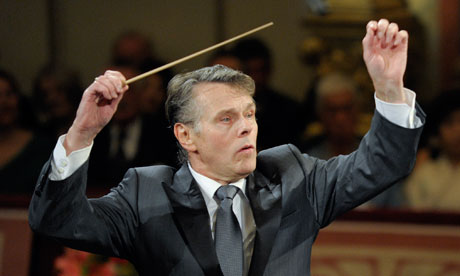
Mariss Jansons conducts in Vienna

‘It's not so difficult to beat in time’: Mariss Jansons conducting the Vienna Philharmonic's 2012 new year concert. Photograph: Herbert Neubauer/Corbis
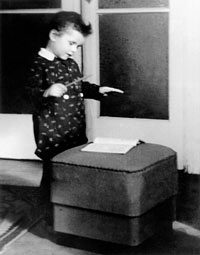
Shoulders down, elbows relaxed, forearms doing the work: the stance is perfect for a conductor. The left hand is shaping the sound; the right, neat and commanding, clasps the baton. Look more closely. Is it in fact a pencil? There's something odd about the score lying open on a satin footstool, with no sign of an orchestra. And that sprigged smock is hardly standard maestro uniform, still habitually white tie and tails. Even the more sartorially adventurous tend not to sport knickerbockers.
Mariss Jansons was three years old when the photo was taken. He is now one of the top conductors in the world, inhabiting that tiny pinnacle of Mount Olympus where a handful of others – Barenboim, Rattle, Harnoncourt, Haitink – jostle at any one time. The cowlick of hair, broad cheekbones, deep-set eyes and boyishly tilted nose are identical to those of the freshly scrubbed, wan but vigorous 69-year-old sitting opposite me in the salon of Lucerne's grandest hotel. His tawny corduroy jacket is neat in the European manner, his navy drill trousers, like his pale blue shirt, crisply pressed. Only the eyes, a clear grey-blue, are a little crinkled, animated by the grins and frowns which are part of his expressive nature.

Mariss Jansons playing conductor, aged 3. 
Mariss Jansons playing conductor, aged 3. Photograph: courtesy Mariss Jansons/Bavarian Radio Symphony Orchestra

Nominating a "best conductor" is a futile activity, but many music connoisseurs, if pushed, would name the Latvian-born Jansons, who is chief conductor both of Amsterdam's Royal Concertgebouw Orchestra and the Munich-based Bavarian Radio Symphony Orchestra. Both ensembles made the top 10 in a 2008 Gramophone list of the world's top 20 orchestras, giving Jansons the limelight as the only conductor to appear twice in the list. He will be in the UK next week to conduct the hallowed Concertgebouw as part of their international residency at the Barbican.
Born in Nazi-occupied Riga in 1943, Jansons was steeped in music from the cradle. His mother was Jewish, forced into hiding at the time of his birth having lost family members in the Riga ghetto. Unexpectedly, he is Lutheran, like his father. "My mother knew it was dangerous for me to be Jewish. In Soviet Riga you took your father's culture and heritage… " The sentence peters out. He is not comfortable with these dark recollections.

Does he remember that infant snap being taken, or the music he was "conducting" at the time? "No, I have no idea," he chuckles. "But I was certainly already interested. My father was a conductor and my mother was a soprano. I spent so much of my early childhood in the opera house at Riga where they worked. They didn't like leaving me at home with a nanny. I soon knew all the ballets from memory and many operas. And it was the start of my fantasy: to play [violin] in someone's theatre orchestra, or maybe to dance and of course to conduct."

He had a toy theatre which has become part of the Jansons mythology. An only child, he played with it for hours on end, staging his own performances. "I'd make instruments out of two sticks, singing my way through music I'd heard. But I was already in effect studying conducting techniques, watching my father or his colleagues even when I was very small." An incipient talent for football, spotted by a local trainer when he was around six, was soon quashed by his parents: young Mariss would become a musician and that was the end of the matter.

The first disruption to this absorbing way of life occurred when the family moved to the USSR in 1956 when Jansons was 13. His father, Arvids Jansons, had been appointed assistant conductor to the powerful and influential Yevgeny Mravinsky at the Leningrad Philharmonic Orchestra. Thrown into a new culture at an awkward age, as well as having to negotiate the highly competitive Soviet education system, the teenager was sent to study violin and conducting at the Leningrad Conservatory. He found the experience traumatic.
"It wasn't so easy. It was, perhaps, one of the greatest difficulties of my life, even though people were warm and welcoming. I was thrust into a higher level of teaching, in a new language which I didn't understand. My father was a famous conductor. I had to make my own mark. I had to be serious and disciplined and work very hard."

Did he then, and does he now, feel in any sense an outsider? In the course of a working day he switches from Russian to German to English, none of them his native tongue. He has two passports – Russian and Latvian. His wife Irina is Russian. "None of this matters to me. I am a cosmopolitan. I work mainly in Holland, Germany and Switzerland. My home is in St Petersburg. I wish countries could borrow the best from one another. I admire, for example, the discipline and respect you find in Japan."
While hardly an advocate for the old Soviet regime, he still appreciates certain aspects. "The educational standards were so incredibly high. It saddens me now that Russia is so much about money and following your own pleasure." Surely his religious belief, a powerful element in his psychological makeup, was discouraged? "How could they stop what was inside me? I did not attend religious ceremonies but my belief was and remains strong. They'd have had to kill me to get it out of me."

After spending a few years as a professional violinist, Jansons worked as a conductor in Leningrad, where he took over his father's old job and spent a while "getting out from under his shadow". He moved to the Oslo Philharmonic as music director in 1979, where he stayed more than two decades but fell out over the lack of a good concert hall (a battle he is now fighting, with minimal success, in Munich). The Pittsburgh Symphony Orchestra followed (1997-2004), but he was never in his element there and found the jet lag exhausting.

Now he works only with an elite four orchestras: his own ensembles in Amsterdam and Munich, plus the Berlin Philharmonic and the Vienna Philharmonic. He refuses to guest conduct with other orchestras. He doesn't, as far as I know, advertise expensive watches. You will not find him acting as a public ambassador for world peace or education like Daniel Barenboim – though naturally he cares about these issues – or attracting the headlines with quite the same certainty as Simon Rattle or Claudio Abbado. Jansons prefers a less showy existence. His close relationship with his musicians is referred to by both sides in terms of a love affair.

"Orchestra have to work with many conductors," Jansons observes. "They want variety. I must always be working at the highest level myself, because that is what is expected of me." This ruthless dedication is one of the reasons his artistry is so valued.

Another is his physical vulnerability. He has a worrying medical history. His father died in Manchester from a heart attack on the podium while conducting the Hallé in 1984. Jansons too, almost unbelievably, suffered the same experience in 1997 but miraculously survived: he had reached the closing pages of La bohème in Oslo when he collapsed with heart failure. He took two years to make a full recovery. His health remains a source of anxiety, especially for his wife and doctors, but he considers himself fit.
"The heart attack was a very dramatic situation," he agrees, with typical understatement. Players told him later that he was still trying to conduct Puccini's score even as he slumped to the floor. "And I suppose I probably was, though I do not remember."

Now fitted with a defibrillator and closely monitored, he tries to live healthily, relax more, eat a good diet and take more holidays. "But for every human being such an event is shocking. You cannot suddenly stop being nervous and anxious about things. You just do your best to manage." His timetable remains hectic. Little wonder he is said to travel with a medicine chest rattling with pills for any eventuality.
"I try not to exaggerate the problem. Sometimes I overwork. The conducting itself is OK. But when you're a chief conductor there is an enormous amount of administration and meetings and other concerns. I am rehearsing and that's already hard work, but I must also be involved in auditions, in deciding programmes and soloists."


Jansons has been with the Concertgebouw since 2002 and is only the sixth chief conductor in the history of the orchestra, which celebrates its 125th anniversary next year. One of his predecessors, Bernard Haitink, 83, will conduct a concert at the Barbican residency. Jansons's own will be devoted to Richard Strauss, whose music is closely associated with the orchestra through Willem Mengelberg, chief conductor from 1895 to 1945. He shaped the Amsterdam sound, and was a close associate of Strauss. Does this give the players a special "Strauss" sound or is that an exaggeration?

"It's difficult to explain, and very interesting, but there is a sort of miracle that happens when they play Strauss, or Mahler too. You can say 'but no one played with Mengelberg. The musicians are international, the playing habits quite different from a century ago, so how can it be?' But there is some sort of spirit, some psychological moment of recognition, and I think you can say that it is a tradition being passed on."
Jan Raes, chief executive of the RCO since 2008 and a former orchestral musician, describes Jansons as "a perpetual student. He's always well prepared. He uses every second of rehearsals efficiently, with no long stories. He gives them everything he has. He is never laid back. All the players feel the pressure to work hard at the highest level, but they are always respectful too."

"Yes, Mariss is mercilessly hard on himself, and uncompromising," agrees Peter Meisel, a spokesman from Jansons's other orchestra, the Bavarian Radio Symphony Orchestra. "After a concert he will get the recording [for private orchestral use] and that same night, after the post-concert event when it is already late, he will listen to it all the way through to see what was good, what was bad." And if he finds errors? "He blames himself."

"My task is to correct," Jansons says. "You must blame yourself if something goes wrong." What happens when he conducts the same works with his two orchestras? Do they ever sound the same? "No completely, totally different! Each great orchestra still has an individual sound, thank God," Jansons laughs. He makes the comparison with having two children (he himself has one, a daughter from his first marriage, who works as a rehearsal pianist at the Mariinsky theatre): "You love them equally and you appreciate and negotiate their idiosyncrasies."

He doesn't mind comparing his orchestras out loud, either. The Bavarians are "in the best sense German, with a big sound and tremendous explosive excitement." By contrast the august Concertgebouw is "transparent, capable of great delicacy, polished, never forced".

In addition to the Strauss concert at the Barbican, Jansons will deliver a lecture on the mysterious art of conducting. "Not everyone can take the baton. The conductor doesn't produce the sound, of course. If a principal woodwind or brass player cannot play a passage, it's tragic. It's not so difficult to beat in time." The virtuosic musicians he works with will play the notes whatever the conductor does, or fails to do.
"So you have to study deeply and express your wishes. The notes are just signs. You have to go behind them and see what your fantasy tells you. But how do you express that through sound? If you think of the technical aspects of conducting as being on the ground floor of a big building, then 20 floors up you are beginning perhaps to get the sound you want."

He checks his watch. He must go. His conducting duties at Lucerne's Easter festival are completed. Is he travelling home to St Petersburg for a rest? "No, I'm off to hear Bernard Haitink rehearsing with my orchestra and I must not be late. I want to see what he does, and how they respond. He is such a wonderful Bruckner conductor, you see. I might learn something."
The very notion, coming from one of the finest Bruckner conductors of our era, seems ridiculous but is, one must concede, just possible.

Wednesday, April 11, 2012

New Commissions and weird dreams- a miscellany blog


I have been away from my blogging for awhile- sorry about that. Some of this time was for composing (yes, that is my main focus!) and also for an extended trip with Sherri and Aidan out to visit composer friend Reg Unterseher, his wife Sheila, and my other new musical friends Justin Raffa and Molly Holleran in Tri-Cities WA (that's WA state) for some fun and Columbia Valley wine-tasting, then up the gorge to Portland for a few days (mmm, Voodoo donuts, Japanese and Chinese Gardens, Deschutes Brewery, Powell Books), and then up to rainy Seattle (wow, Pike Place Market and the Seattle Aquarium are great). But now back to blogging.

Some little things (items A and B) and then some cool announcementy stuff (Item C).

Item A

I'm off tomorrow to Ch-Ch-Chattanooga to present a session at Tennessee MEA. Should be fun and hope to get to know some TN people better. They have already contracted me to conduct their honor choir and be their commissioned composer for 2015-pretty exciting. I've never been to Chattanooga so I have no idea what it is like- maybe I should research the town for a few minutes- or, anyone out there, hollerup what there is to do there beside being a music conference nerd.

Item B

Wow, I have no idea why, but I've been having those ridiculous school dreams that, for me, mostly stopped years ago. You know the dream- you haven't been to class in forever and now all of a sudden you have to pass a final test or write a term paper in one night. THOSE stupid dreams! At least mine progressed from being about HS to being about college over the years- and they did gradually disappear as I became older. But here is what happened recently- three of them clumped together in the space of about ten days!

Dream #1- I dreamt that I had been MIA from my college composition studies for a long time and all of sudden decided to get back to it. I actually felt good about this in the dream, yet people were a bit mad that I had disappeared. One professor yelled at me that I better go find my main prof and get to work. I seemed to have been away 2-3 years and the dream told me nothing about what I had been doing for that time (maybe working at Voodoo Donuts?).


Dream #2 - in this dream I found out I was to play a piano concerto in a few hours with a famous conductor. It was a difficult piece I knew from years ago (maybe one of the Bartok concerti?) but hadn't played in years! For some odd reason, instead of practicing the piece in the few hours I had left before the downbeat- I was mostly paralyzed worrying about it. Thankfully the dream ended before I had to go onstage.

Dream #3 - similar to #2- but in this case I was to be the baritone soloist (who, me? that's funny right there) in a large piece, something like the Brahms' Requiem I suppose, and I had never sung it or looked at the score. Again I wasted the few hours before tipofff worrying instead of practicing. I didn't even want to try to warm up and figured that somehow I would sightread the whole damn thing. An alarm clock woke me up before this disaster transpired in dream land.

Weird stuff- but I guess the good thing is I had pants on in all three dreams- that's a plus, right?

Hey y'all- if you want to share an annoying dream that only we dumb musicians have, please write in. First person to share gets a free pack of Hostess Twinkies- the delicious and healthy snack treat invented right here in Oak Park, IL

Item C

Okay now to get serious- I am very happy to announce two new commissions for next season (and please note that I still have room on my plate for a few more commissions large or small): I have been chosen as one of three composers to write a new piece for the ACDA Women's Choir Commissioning Consortium. Iris Levine emailed me a little while ago and told me this. I was very pleased as I have followed the history of this fairly new project and was hoping that my name might be on their radar sooner or later, since I do write so much women's choir music. The list of choirs is impressive, mostly great college ensembles, but also some forward-looking adult choirs and a few very ambitious HS programs- a total of 31 choirs (most of the directors I know). This is an awesome project for a composer- since instead of the usual commission being for one choir and then you never know when that second performance might happen, the composers involved now get many performances right away from some really great groups. I am looking forward to working with some of them and/or perhaps attending some of the concerts if I can. I have already chosen a text, Ariel's song "Full Fathom Five" from The Tempest and Iris has approved the text. I also have started sketching the piece and am pretty pumped with what I have so far. I had originally been looking for a modern text like I usually use, but I had been studying some SATB settings of this text for a totally different project and began to like the text more and more. And it being in the public domain makes my life quite a bit easier as a composer. Anyway, I am thrilled to be chosen for this project and hope that my final product will be liked by most (all?) of the choirs in the consortium. Iris and I also discussed (as well as email help from Deb Spurgeon, Iris' predecessor as head of the project) how to succesfully write for these various groups. My take on it was that the collegiate groups want at least some amount of challenge, so I am giving them that challenge at times while making sure that the less advanced choirs can still handle the issues- I'm pretty good at providing "help" for tough things with various compositional tools. It doesn't hurt to have conducting experience, especially with a women's choir for five yeas, plus having attended countless concerts and interest sessions- there are plenty of ways to compositionally finesse and help choirs with what at first looks difficult.

I was also asked to be the commissioned composer for the 34th Annual Ithaca College Choral Festival in November run by Larry Doebler.


This is a big event with the Ithaca College Choir and high quality area high schools participating for 2-3 days. Part of this event is also a composition competition for young composers which I believe has yielded a number of quality pieces over the years. My piece will be sung by the college choir as part of the final concert presentations where the winners of the composition contest are chosen by a panel that include Larry, Janet Galvan, and at least one other judge. I'm a bit humbled by this one- the commissioned composers over 33 years are a bit of a who's who- Norman Dello Joio, Vincent Persichetti, Daniel Pinkham, Dan Locklair, Chen Yi, Lowell Lieberman, Rene Clausen, Steven Stucky and more. I guess I better write something killer!

So that's my blog today- a weird mashup of Chattanoogas (isn't that the sound that 0ld-timey car horns make?), strange dreams, and great opportunities to write music for wonderful people!

Paul